
WHySE Compass Landmark 7
Trilogue – Legislation in the European Union

Monkey and the Tolkien Trilogy
Monkey arrives on the veranda with three books under her arm. Rat is already there, the pile of papers from Brussels in front of her. Snake has taken the seat beside her.
“Dog!”, says Monkey. “You have to help me. Rat keeps going on about a trilogy from Brussels. At first I thought that was a book in three volumes. Like Tolkien.”
“Almost,” says Snake drily. “Three volumes, one work – that’s how Tolkien saw it. And Brussels sees it the same way: three parties, one text.”
Dog puts down his cup. “Then let’s sort this out properly today. It’s exactly the question many people daren’t ask.”
Rat pushes the pile to one side. “Last week I thought the hydrogen quota was gone (Episode 37). Now they say: someone is negotiating. I’m losing track. How does a law actually come about?”
What is the trilogue?
Snake raises a finger. “From the beginning. The trilogue is a negotiation. Not a law.”
Three institutions negotiate there:
- the European Commission, or Commission for short – it proposes,
- the Council of the European Union, or Council for short – the governments of the member states,
- the European Parliament, or Parliament for short – the elected members from the 27 member states of the European Union.
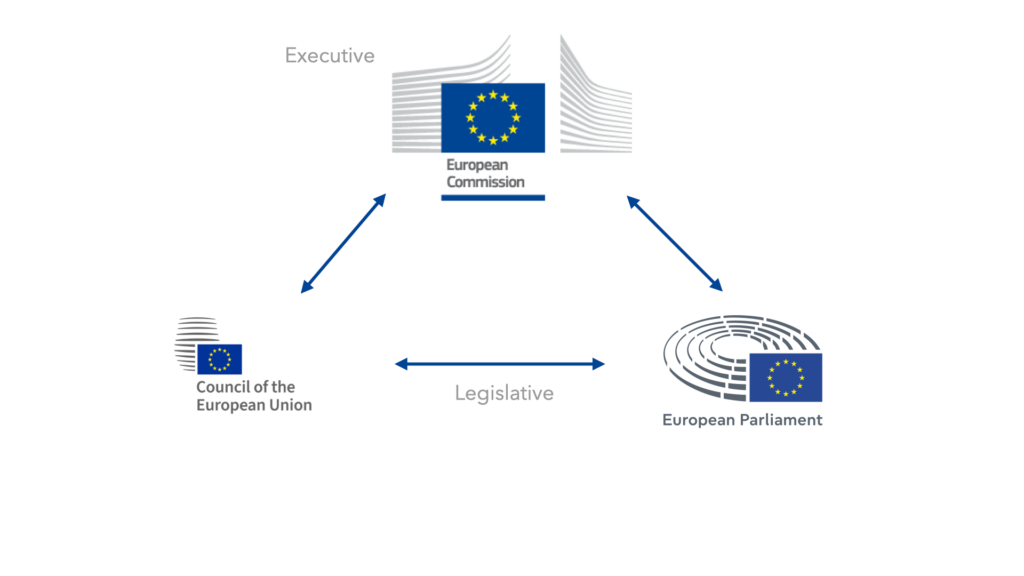
Commission, Council, Parliament. Three parties, hence the name. The Commission chairs. Council and Parliament put forward their positions. At the end stands a compromise that all three can carry.
“And until we get there?”, asks Monkey.
“Until we get there, the text has a whole journey behind it,” says Dog. “And that journey starts much earlier than most people think.”
The journey of an EU law
First: the consultations – and they keep running
Before the Commission puts forward a draft, it asks the public: affected companies, associations, experts, individual citizens. Roadmaps are published, impact assessments written, questionnaires sent out – via the “Have your say” portal, in all 24 official languages of the EU.
But – and this is the important part – the consultations don’t end with the proposal. The draft itself is also put out for public feedback. And existing laws are reviewed later, again with the opportunity to have a say. A consultation isn’t an antechamber you pass through once. It’s a companion who rings the doorbell again and again.
Rat looks at her pile. “That paper there – is that the proposal?”
“No,” says Snake. “That’s an impact assessment. A working paper. The draft comes after that – and it, in turn, can be commented on.”
Second: the Commission’s proposal
Now things get going. The Commission holds the sole right of initiative. Its draft travels to two houses: the Council and Parliament. There it is debated, amended, argued over.
Third: the trilogue
If Council and Parliament agree, the text is adopted quickly. Usually they don’t. Then all three sit down at one table and negotiate position by position. The result is a provisional agreement. The Council and the Parliament’s plenary then confirm it formally.
In practice, this happens remarkably often: around 90 per cent of Parliament’s legislative files were negotiated and adopted in this way at first reading.
Fourth: adoption and the Official Journal
Parliament and Council adopt the text. It is signed and published in the Official Journal of the European Union. Only now – and not before – is the law a law. Anyone who wants to read it will find it on EUR-Lex.
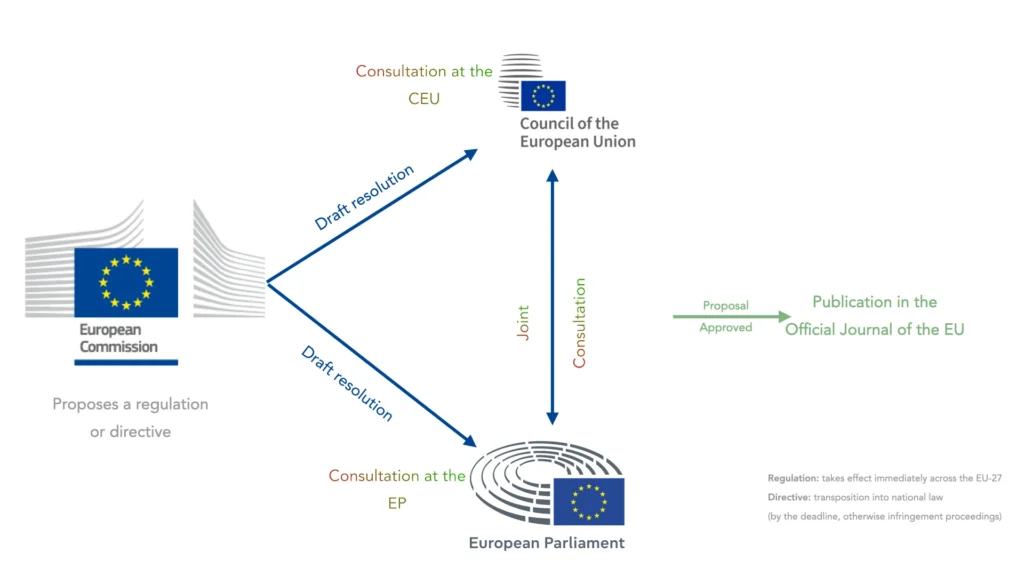
Monkey counts on her fingers. “Consultation, proposal, trilogue, Official Journal. And then it applies?”
“Depends,” says Dog. “And that’s exactly where your second part comes in.”
Regulation or Directive – the crucial difference
“Two kinds of legal acts,” says Snake. “The regulation and the directive.”
The Regulation applies directly. From the day of publication in the Official Journal, in all 27 member states, in the same wording. No national discretion. A well-known example: the REACH Regulation 1907/2006 on chemicals.
The Directive sets a goal. How the member states achieve it is up to them – within a deadline, usually two years. It must be transposed into national law. Example: the Water Framework Directive (WFD) 2000/60/EG. In Germany it became the Federal Water Act (Wasserhaushaltsgesetz, WHG), with scope for the existing rights of the Länder.
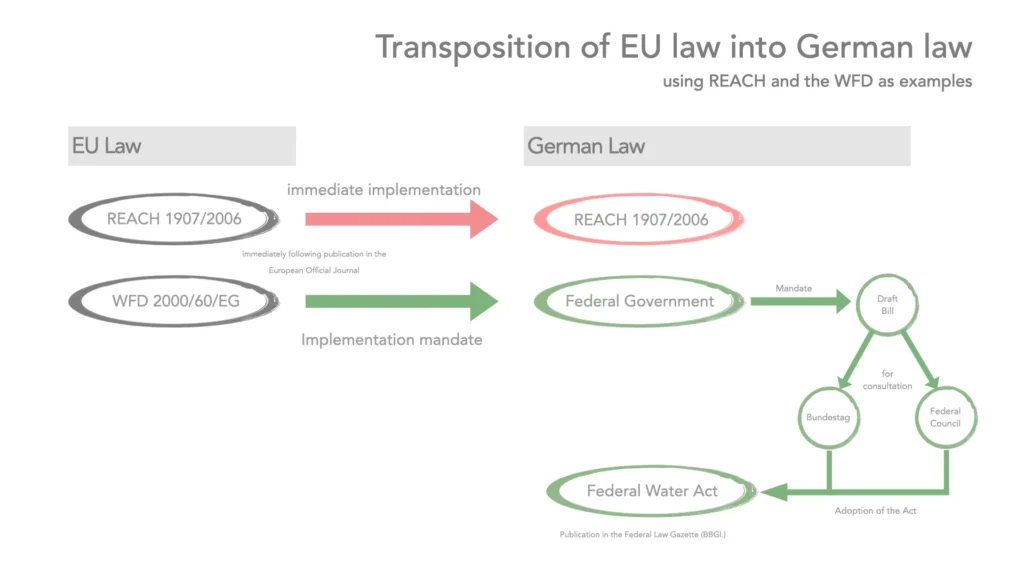
Dog points at Rat’s pile. “And your Renewable Energy Directive is a directive. Which means: adopted in Brussels is not the same as in force in Germany.”
“How many states have actually transposed the current version?”, asks Rat.
Snake smiles thinly. “By May 2026, eight of the 27 member states had fully transposed the hydrogen mandates. Others are still working on it. Some are already before the CJEU.”
Rat leans back. “I see. Adopted in Brussels doesn’t mean adopted in Bielefeld.”
Common misconceptions
“Leaked’ means ‘adopted.” No. A working paper is not a draft, and a draft is not a law. (Episode 37 sends its regards.)
“The trilogue is the law.” No. The trilogue is the negotiation. The text only becomes law with its publication in the Official Journal.
“What Brussels adopts today applies in Germany tomorrow.” Only for regulations. Directives need national transposition – Bundestag, Bundesrat, an act of parliament.
The Creatures’ perspectives
Rat asks: “When do I need to act as a managing director?” – At every genuine step: proposal, agreement in the trilogue, Official Journal. Never at a headline.
Snake adds: “And anyone who wants a say should join the consultations. After that, it gets considerably harder.”
Monkey asks at the end: “And what if Council and Parliament can’t agree in the trilogue at all?” – “Then there’s the conciliation procedure,” says Snake. “In practice, the exception. Usually the table for three is enough.”
Dog’s guidance
Anyone planning in the H₂ terrain needn’t fear headlines from Brussels. What they need is an order of questions: What’s on the table? A working paper, a draft, an adopted text? Is it a regulation or a directive? Is it in the Official Journal – and if so, what does that mean for Germany?
Anyone who asks these four questions can put any headline into context in ten minutes.
Anyone who wants a say will find open consultations via the Commission’s “Have your say” portal – some are already running while Council and Parliament are still deliberating.
The plain-text version
When someone talks about the trilogue, they mean: the Commission, the Council and Parliament sit down at a table and negotiate for as long as it takes to turn three positions into one joint text. The text only becomes law when it is published in the Official Journal. And whether it hits you directly is decided by the last word: regulation or directive.
If you want to remember just one sentence
The trilogue is the table at which the Commission, the Council and Parliament turn three positions into a legislative text – and whether it hits you directly is decided by the label: regulation or directive.
Sources and notes
Treaty on the Functioning of the European Union (TFEU), Article 288 (legal acts) and Article 294 (ordinary legislative procedure)
European Commission, “Planning and proposing law” – consultations at all stages, “Have your say” portal
European Parliament, “The ordinary legislative procedure” – the process from proposal to adoption, public hearings
EUR-Lex, summary “Directives“ (transposition deadline usually 2 years)
European Hydrogen Observatory (RED III transposition status, May 2026)
Note:
This landmark does not replace a legal assessment of your project. It provides orientation
The Compass is Ready
The WHySE Compass grows with every question.
Some cards have already been turned over. Others are still waiting.
When Dog explains a term, the card gets its own image. There you’ll find the explanation, sources and – for specialist landmark – the PDF to take away.
Not everything at once.
Just the next landmark.