
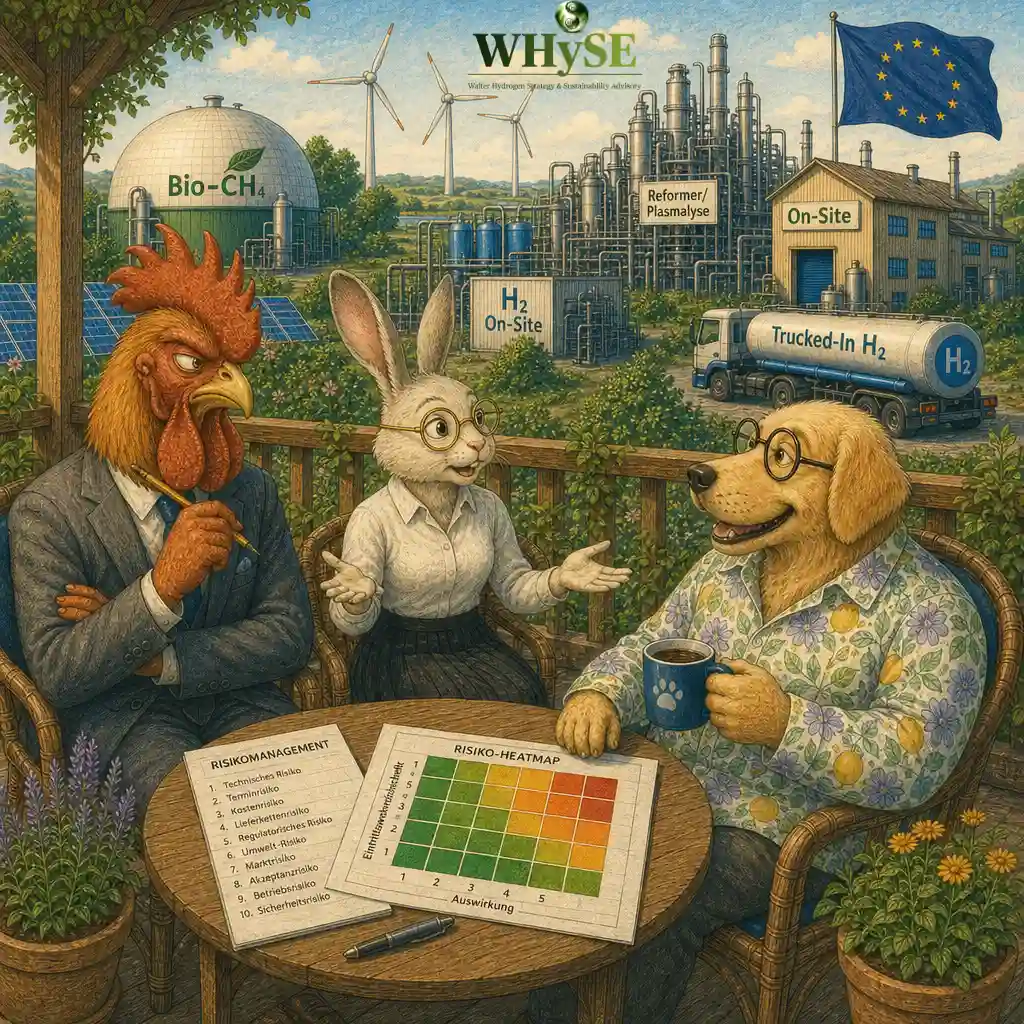
Episode 36 of the WHySE Creatures Stories
This post first appeared on LinkedIn on 1 October 2026.
“We’re starting on Monday. Then let’s get the project underway.” Rabbit is sitting on the veranda with Dog. Rooster is already seated at the table, a thick folder in front of him.
“Before you rush off, take a deep breath,” says Dog. “Have you also considered the risks?”
Rooster opens the folder. “All possible risks have been assessed. Probability, impact – it’s all in the matrix.”
“Excellent, my dear Rooster. But who owns the first risk?” asks Dog.
Rabbit and Rooster look at Dog in silence.
“And,” continues Dog, “by when must the mitigation measure be in place? Who decides whether it’s sufficient?”
Rooster replies: “I’ve included all the risks in my list. Surely that must be enough?”
Dog smiles. “Your list documents potential concerns, Rooster. However, it doesn’t manage anything. Risk management is more than just a table. It links the risk, its potential impact, the measure, the risk owner, the deadline – and the decision.”
Rabbit asks: “So, names first, then pace?”
Dog nods. “Pace doesn’t come from rushing off. It comes from clarity about who decides what by when. Projects rarely fail because of one big mistake. They fail because of many small unresolved issues for which nobody is responsible. For large and complex projects, a neutral body that keeps all the threads together helps – a PMO (Project Management Office). It’s an offer, not an obligation. And it starts with a simple rule: a risk that isn’t named isn’t risk. It’s like an uninvited guest at the table. They are present, but nobody looks after them. Even though somebody should.”
“And it wanders,” says Rabbit.
Dog adds: “From table to desk. Until it shows up again later: as a scheduling problem, as an amendment, or as a missing decision.”