
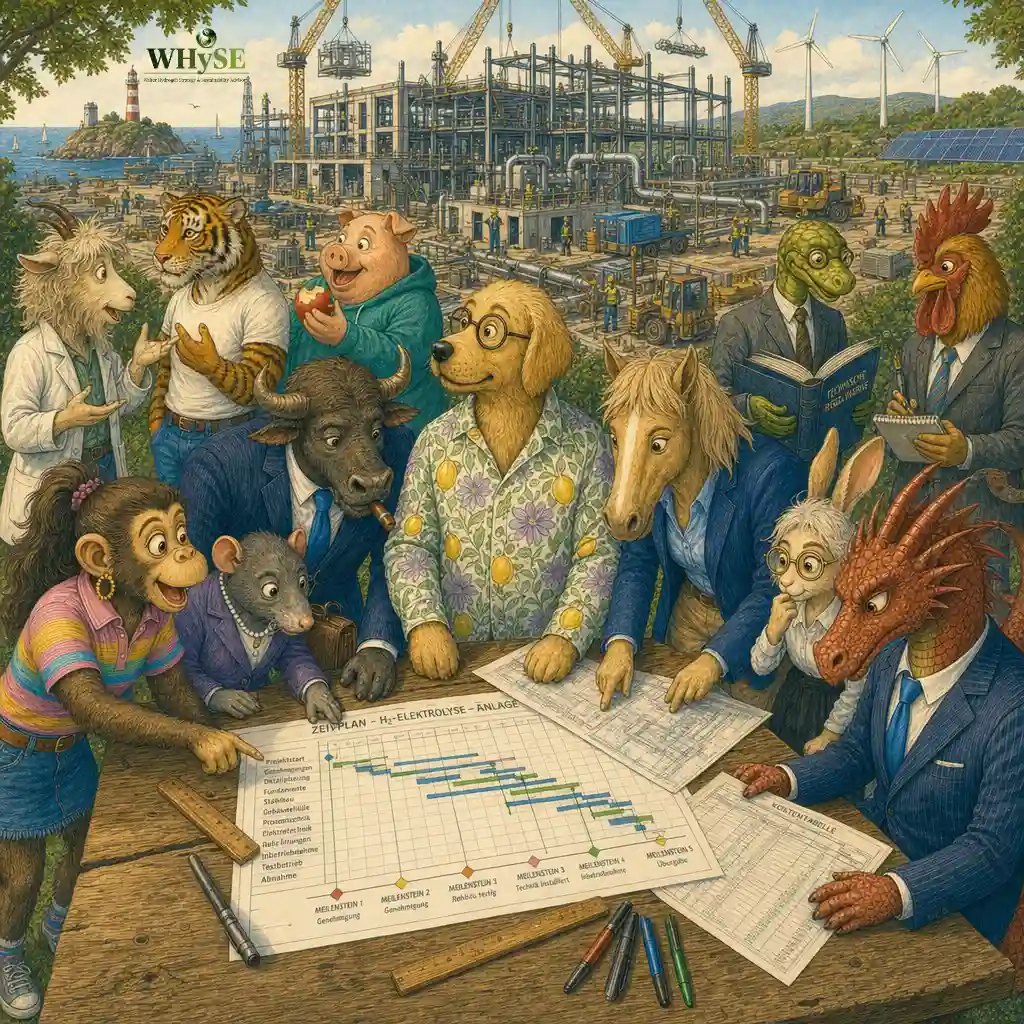
Episode 32 of the WHySE Creatures Stories
This post first appeared on LinkedIn on 17 September 2026.
“Milestones carefully placed and clearly defined –
and they become signposts for the project,” remarks Dog, putting his pen aside.
Rabbit looks at the large project schedule.
“Hmm. Milestones indicate when something is supposed to be finished, don’t they?”
“Yes, dear Rabbit,” says Dog. “And they can do much more than that.”
Dog recalls GreenAir, a research and development project involving Airbus and many other partners.
Before GreenAir, he understood milestones in the way Rabbit describes them. They structured the project, made progress visible and gave the team intermediate targets.
At these points, the team checked whether it had achieved the agreed outcome. Whether the quality of that outcome was sufficient to support the next step remained open.
During GreenAir, Dog learned how to combine a milestone with a quality gate: a defined quality review and decision point.
Are the results complete?
Do they meet the agreed quality requirements?
Is the current approach still viable, or does it need adjusting?
This turned the milestone into a signpost.
“And did that make the project run more smoothly?” asks Monkey.
Dog thinks for a moment. “Above all, it brought structure and clarity. Sometimes it even caused disruption when the results showed that the approach taken so far should be discarded. We recognised this early and were able to make a conscious decision.”
“Then let’s set as many as possible,” says Rabbit, reaching for a pen.
Dog smiles. “Their timing matters too, dear Rabbit. In a construction project, quality gates accompany the entire process. In research and development, they come early enough to influence the direction – and late enough to assess robust results.”
When such points are missing or poorly timed, quality issues may emerge too late. Decisions are delayed and project costs can rise.