
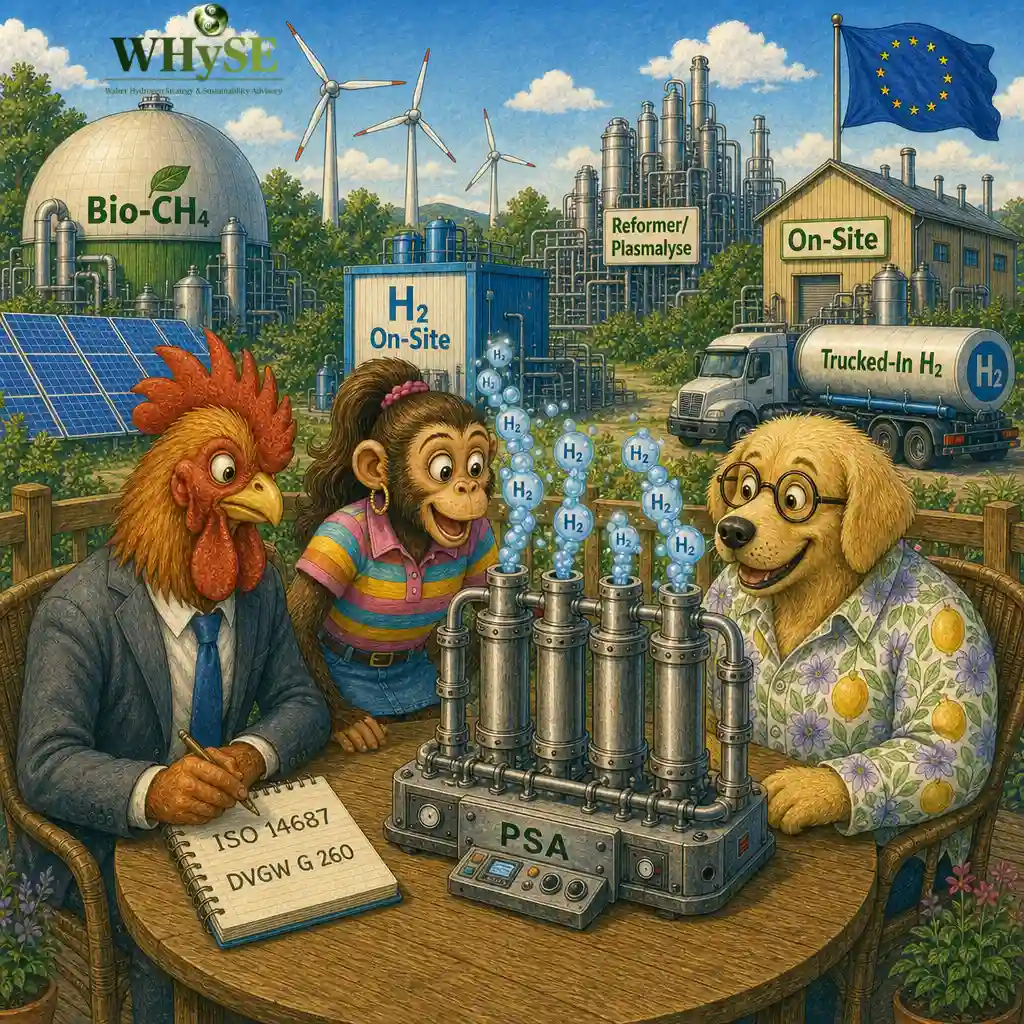
Episode 33 of the WHySE Creatures Stories
This post first appeared on LinkedIn on 22 September 2026.
“Pure hydrogen –
how pure, exactly?” Monkey asks Dog.
Rooster lifts his head. “You mean: what characteristics must it have?”
“No,” says Monkey. “I really mean: how pure is it allowed to be?”
Dog puts down his cup. “As pure as its intended use or the requirements demand.”
For hydrogen vehicles with PEM fuel cells, ISO 14687 ‘Hydrogen Quality’ is an important quality benchmark.
“And it sets limit values for individual impurities,” adds Rooster.
Dog nods. “It is precisely these substance-specific limits that are often more meaningful than a simple overall percentage.”
In the electronics industry, the requirements can be even higher than for hydrogen vehicles, as high-purity substances are crucial in production. In the steel industry, however, where iron is produced via direct reduction, the situation is different.
“What needs to be taken into account when hydrogen is to be fed into the gas network?” asks Monkey.
“In Germany, the requirements of DVGW Worksheet G 260, ‘Gas Quality’, apply,” explains Dog. “Hydrogen belongs to the fifth gas family in that document.”
Monkey frowns. “And how does it become so pure?”
“Through pressure swing adsorption, for example. In short PSA. Porous materials bind impurities under elevated pressure. The purified hydrogen flows on. I developed such a PSA system myself. The technology is still used in HyGear’s systems today.”
Membranes can also be used for hydrogen purification. The selection process begins before the technology itself: Which substances do we need to separate? At what pressure and temperature? What gas properties does the application require? And where do the separated components go?
This is precisely where Dog builds the bridge to practical application. Higher purity sounds better at first. However, insufficient purity can impair fuel cells, catalysts and processes. An unnecessarily high specification increases effort, energy consumption and costs. Depending on the process, the hydrogen yield may also decrease.